Featured

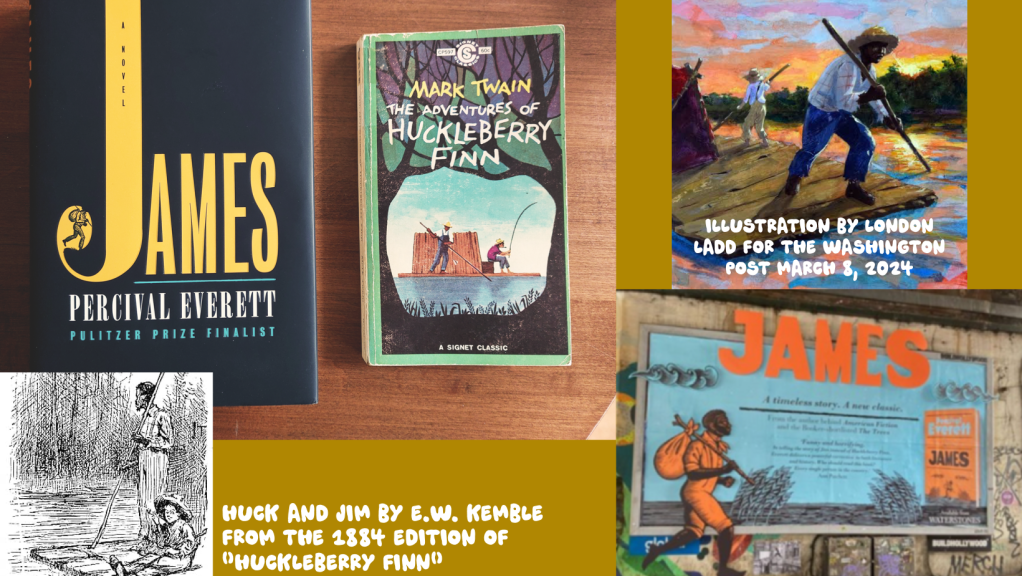
Descendants of Wood and Water: A Book Review – “James” by Percival Everett

In the Beginning– This will likely be more than a book review, as this book is more than a book. It’s a love letter of sorts, perhaps even a postcard sent from abroad, a Polaroid snapshot of a renamed landscape encompassing both past and future. Everett deserves all of the accolades garnered. Let me start by saying that I have never met a James I did not like. James – Hebrew and Latin in origin, meaning may God protect. Rarely a name placed in the middle, it fares well as a first or last. And this is interesting. Though there is indeed power in a name, the way one yields said power is the real essence of their being. Everett does not frame his main character as a simple hero. But instead as a teacher. Perhaps reluctant at times and even with an air of tongue-in- cheek, James (Jim) is a protagonist that teaches whilst surviving. He seems to be shielded by a force unseen as the adventure framework of Huckleberry and Tom (children, male and white) are nightmares manifest to James (adult, male, and black). Everett makes the reader want to know of this otherworldly force unseen that seems to walk, run, swim, and even rest with James. I watched the The Book of Eli while reading James. I’m learning to not be so spooked when synchronicities cuddle up in my lap. The watching and the reading of these two works of art was just that – a wading synchronicity highlighting the importance of language, literature, literacy. Toni Morrison proclaimed, “…we do language. That is how civilizations heal”. There’s much healing to be had in pre and post war, apocalypse, growing up (not to be confused with simply aging). Language gauges the degree of separation. Finally, we realize we are and have been shoulder-to-shoulder. The separation, a mere facade in the desert, and a white lie on the plantation – salt water to the thirsty, and a pine box to the finally free.

The Word– The novel is set in Hannibal, Missouri – a necessary nod to Mark Twain’s original novel. I would urge the reader to research the term Hannibal past the knee-jerk allusion to the psychopathic doctor namesake (although, that may be relevant as well); and also accept the phonetic similarity of the state name and term Missouri & misery respectively (as this is also relevant in my opinion). Jim is self-taught and duplicitous in his use of language. The word – his safe place, a hiding space or stage depending on the situation. He is careful of his use of proper vernacular not only because it could reveal his learned state and thus position him as a threat to his oppressors, but also because his movement throughout the world (whatever and whichever world) depends on it. James utilizes ‘slave talk’ when needed but teaches, dreams and narrates in proper English where secure and applicable. The point is: in a world banking on him not knowing, he does indeed know. He is faced with being sold away from his wife Sadie and daughter Lizzie to another plantation down in New Orleans. Upon deciding to run, James is followed by Huck who has faked his own death in an effort to escape his father. The two hide out across the river on Jackson Island and thus begin the adventures of Jim and Huck? The search for Jim and Huck? The trials of Jim and Huck? The story of James. Everett is adamant in relaying the dualities that reside in James as well as his tricky positioning. His only possessions are not even the clothes on his back; they are a waterlogged notebook and a pencil gifted in blood. His station in society is runaway slave although he has a wife and daughter. His main companion on his journey away from and back to the plantation is a little white fella who he just can’t seem to shake. Thus, Everett makes a clear point – one’s simple may be another’s very complex. Moreover, Everett’s depiction of Huck’s refusal to be excluded from the story of James is a word within itself.
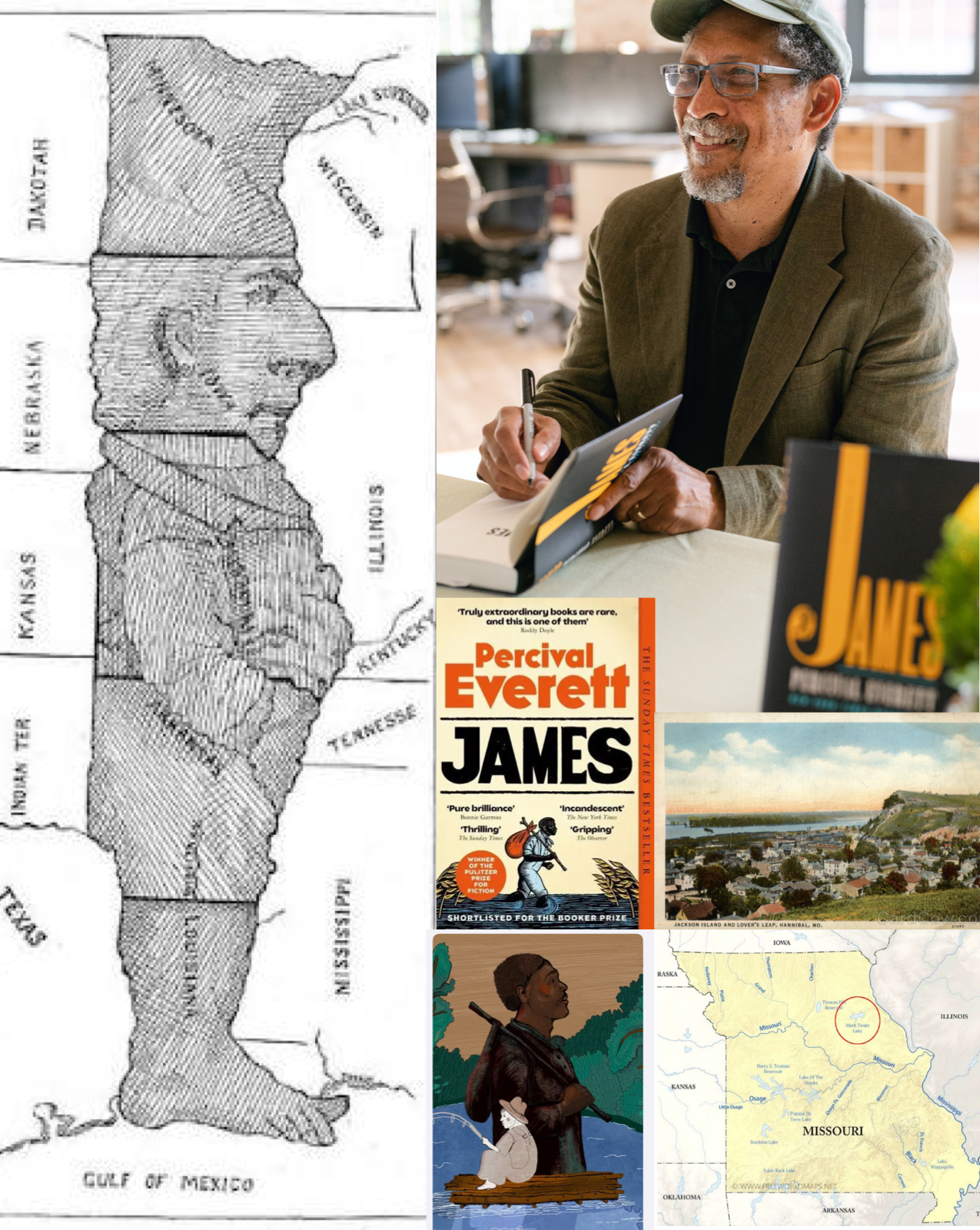
The Belly– Jim and Huck are separated on multiple occasions; their separations preceded by multiple strikes…of steamboat, of ally, of human sale, and of truth. I think when one strikes the truth it makes a sound. Like a massive tree toppling into a large body of water or like a ship splitting in two, like a paddle striking flesh. Everett makes a point with the splitting of wood and splashing of water as these two are desirable yet problematic; much like lumber for burning and Adam’s ale for sale. The complexities of coupling necessity with exploitation is loud and evident. This system of slavery has touched every character in this story and left behind a smoldering

destruction. Everett does not allow for debate in this area (rightfully so). Each introduction of a new character or character group places Jim and/or Huck in a sort of love below situation – just above the reproductive parts but below the heart and mind. Each separation of the two leading them to inevitably find each other again as they run into polarities that will either yield rebirth or regurgitation. Everett is clever in his depiction of the duo’s interactions with others. This humanistic need to form alliance, friendship, family – is it a welcoming invite of pure intention or a methodical crash?.

“…just because someone desires you, it does not mean that they value you. Desire is the kind of thing that eats you and leaves you starving.” -Nayirrah Waheed

The Beast– Indeed, there are many meetings of mind, heart and soul in James. The four black men hovering over an awakened Jim signals his arrival to Illinois and the horrific value (or cost) of a writing utensil. Huck returning with two criminals relays the extraordinary utility of self-proclamation and the ridiculousness of playing church. The introduction to Easter (an elderly slave and keeper of a livery) informs the reader that even sleeping unshackled comes with consequences. James’ singing voice summons The Virginia Minstrels and a surface agreement is made – common decency in exchange for black face and a fondling of the mind’s area without consent. Our introduction to Master Henderson expands upon this lack of consent as Henderson runs a brutal sawmill and has been raping little Sammy since she was pre-menstrual (again, I urge the reader to explore the phonetic kinship of menstrual & minstrel). Sammy runs with Jim and is eventually a casualty of stripped femininity, stripped lineage, stripped safety, stripped language. Working with wood from sun up to sun down and finally meeting her end as she is shot while attempting to escape across a body of water; she is a casualty of slavery. Jim and Norman’s arrival onto a riverboat reveals the machine’s crazed engine – a slave named Brock in charge of feeding coal to the boiler and making the boat…go. Through Jim and Norman’s interactions with Brock, Everett makes a finite point – the system is unsustainable; no one thing (coal), person (hydro-power), place (wood) can satisfy this beast.

“One must say yes to life and embrace it wherever it is found — and it is found in terrible places; nevertheless, there it is.” -James Baldwin

The Beauty– Jim and Huck are jolted back together following the explosion and sinking of the riverboat. James’ desire is made clear – he wishes to be reunited with his wife and daughter. However, the means of acquiring them has also been made clear – unsustainable, treacherous, a feeding of an insatiable beast. The duo return to Hannibal and in Jim’s old cabin they do not find Sadie or Lizzie, but rather a new slave couple by the names of Cotton (go figure) and Katie. It is as though they’ve returned to a scene from Jordan Peele’s Get Out. But though the scene is the same, neither Jim nor Huck are. They have gained a new knowledge about how the world works, how Hannibal Lecters are born of a naughty child’s Christmas gift, how blindness can be both a gift and a weapon, how passing doesn’t keep one from passing away, how mention of a breeding house can drive a man mad or crash him into sanity. We can see the dots, the zeros and the ones and we know (almost immediately) that Shonda Rhimes did an excellent job at depicting a grown-child Huck and a hair-touched Olivia Pope. Jim can no longer offer Huck the gift of blindness and so he offers him possibly the next best thing(s) – the gifts of truth and choice. As Everett informs the reader of the impending Civil War, Huck is now armed with the truth of paternity coupled with the truth of societal workings. Jim learns through Sammy and Katie that 🎵 nothing even matters 🎶 past the realization that the vulnerable portals of life can be sold, maltreated, and bred. This system does weird, nasty things with the ideals of consent, rights and wrongs. In 2025 it seems like a far-off concept, something in the past too terrible to see the light of day. In 2025, Everett is telling the reader to get their head out of their asses; the oldest professions (prostitution, scamming/thieving, lay preaching and soldiering) prove staying power if nothing else. And, Civil War is already amongst us. Who else would they put to work and to war if not the descendants of wood and water?

The Rest– James lays to rest the ideology of ‘doing good for goodness sake’ and awakens the notion of ‘faith without works is dead’. Both the overseer Hopkins and Judge Thatcher receive lessons before their penalties are enacted out by Jim’s hands and faculty. Jim makes it to the Graham breeding farm and sets the surrounding cornfield ablaze ultimately leading to the farm owner’s own penalty and the freeing of the slaves. Iowa is the landing spot for James, Sadie, Lizzie and a few other escapees. When asked of his nomenclature, James offers up yet another lesson that Everett leaves open-ended. Here’s my take: whether you are walking with the King James version of yourself or standing up in the first-name only, every version of you deserves to know you are there. And the novel seems to fall into a sort of calm resting place…on a bed of structured (yet creaking) wood cradled by a churning (yet steady) water. Percival Everett did a thing with the novel James. A Go(o)d thing.

👓 This Book Review is dedicated to my paternal grandfather and very own JAMES P. EASTER. Love you PahPah Perry! ♥️

Work(s) Cited:

Baldwin, James. (1963). The Fire Next Time. United States: Dial Press.

Everett, Percival. (2024). James. United States: Doubleday Publishing.

Waheed, Nayirrah. (2013). “The Color of Low Self Esteem”. Salt. CreateSpace Independent Publishing Platform.
Featured

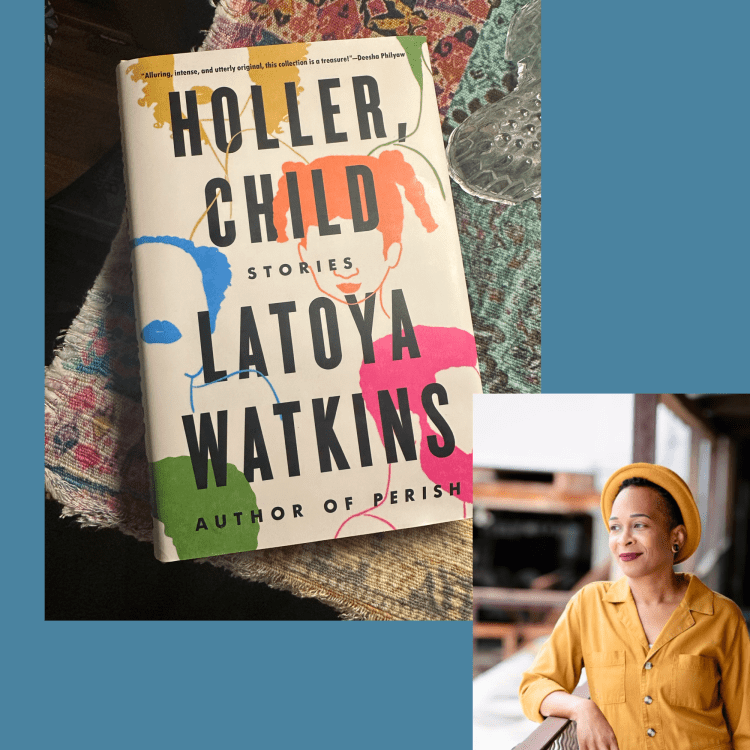
Window Pains: A Book Review – “Holler, Child” by LaToya Watkins

There are eleven heart-moving stories placed into this collection by Texas author LaToya Watkins. Each story is tossed at the reader in an endearing manner; a manner that sets the reader up to succeed – to catch, to understand and to answer back truthfully with their own mental and emotional grasp and release. There are recipes beyond the eleven windows we gaze through in Holler, Child. Recipes that have been lost, and found again. But first, there is the pain that must be drudged through – the questions that linger on the window seal like sharp shards of glass. How did the stovetop get so dusty? When did the inhabitants decide that these walls were suffocating? Why would grandmother store the recipes in the bedroom instead of the kitchen? What did she mean by…a pinch of nutmeg? Watkins’ stories are a pinch of this and a pinch of that; made successful by the atmosphere(s) of home and the pursuit of love and somebody (or some thing) knowingly or unknowingly helping you decipher a recipe written by hand on oxidized paper in ancestral dialect. Sure, we might holler in joyful glee when we get the recipe right. But, we can holler too, when we need some help.

The Mother – The first of the stories is of mother and only son. We journey through beckoned (even reluctant) storytelling as the glass gets thin enough to shatter. And we see that stories are not just what we make them but also for whom they are made. Watkins traverses the story of an only son’s coming to be and how he is to be remembered once gone. There are a number of characters who make it through the mother’s threshold soliciting the narrative of the only son, but the one that elicits validation (true or otherwise) is the only one left who can return the sentiment.

Time After – The eleventh and last story in Watkins’ collection is titled without fault and moves like a song. Alluding softly to the collection’s first story, we are again in search of an only son – his story and its edits; the oracles being the women in his life sharing a good part of his genealogy, childhood and rearing. Time After seems to function as a purposeful conclusion to this collection with the ever-present theme of understanding scaffolding the tales. It pulls at the parts of you that deeply ask why, wishes things could be different, hopes to make a fool out of both patterns and time. But because no one has ever really truly been successful at making a fool out of time, we lament to being present for those we truly love (time after time).

This is a necessary collection of short stories with timeless depth and span. Stories two through ten are the guts and the oozing filling in the dermis that are stories one and eleven. Watkins brings her characters to life during both the pinnacles and valleys of their evolution. Each story has a holler mechanism – the jubilation at the end of the search, the tribulations surrounding the time in-between, the peeling back of scar tissue to reveal the real wound. The recipes function as both the tracing backwards and the leaning forward. Like a string of museum exhibits – all eleven lined up in a row; a separation of thick glass between the exhibit (the story) and the voyeur (the reader, sans ick). We look through the glass window of each exhibit while Watkins guides us through the joy, the journey and the pain. Though we may not be left with a cake, or pie or even bread, we are indeed left with a homemade holler heard through the thickest windowpains.

Work Cited: Watkins, LaToya. (2024). Holler, Child. Tiny Reparations Books.

Featured

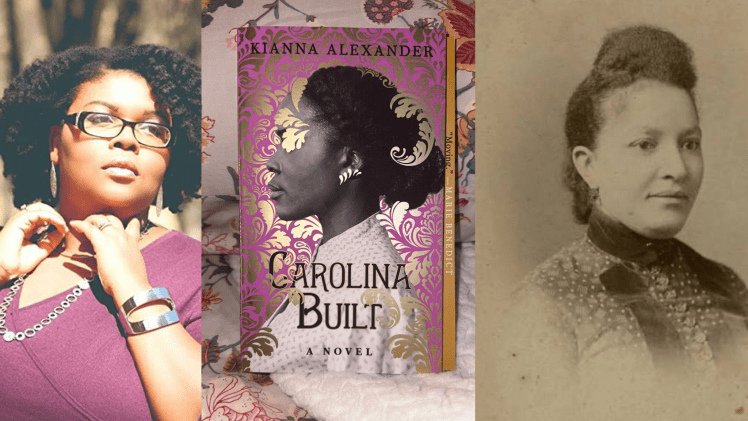
Built; Not Bred: A Book Review – “Carolina Built” by Kianna Alexander

Carolina Built is set in the post Civil War wetlands of North Carolina. Most from ’round this way (up and down the southern east coast) have ventured there; many have roots there. Though the official genre is historical fiction, it is my opinion that it reads as non-fiction, factual, true…as in the words of Richard Wright, “I did not know if the story was factually true or not, but it was emotionally true.” Josephine N. Leary is the main character as the book is based mainly on her life, ambitions, and building of legacy. Kianna Alexander makes a point with her literary portrayal of Josephine – ambition and grit can get you far; but it’s not the lengthy distance from point A to point B that makes you, it’s the variability, the ups and downs, the trusting in high country even though you have a deep knowing of the low country.

Alexander’s story-telling in Carolina Built is a nod to a time with prominent dualities – simpler yet requiring the utmost grit, analog yet progressive, rooted yet free of mind. It could be said that Josephine has the will to purchase her own shackles (because she can, not because she’d ever wear them). Formerly enslaved, we are gifted her process of becoming a wife, a mother and a successful real estate mogul. She’s fire – a one woman dynasty of sorts. But, as Alice Walker writes, “the world is too wet to be a machine”. We see her community and bloodline show up in the spaces where Josephine’s fire needs quenching; and where her vulnerabilities arise. Can she have it all? What is the price of having it all? And how much taking can suffice before the give has its hand out? Edenton, NC had a sweet spot timeline thereafter the Civil War – a timeline built of brick structures like true community, marriages, defined roles, sturdy handshakes, a grown man’s word, a grown woman’s vision. There were not many loopholes allowing for the back-and-forth that exist today. Josephine thrived in this space and time, so much so that even when literal and figurative fires burned down literal and figurative dreams; rebuilding was doable. I suppose rebuilding is always possible…when the land is one’s own.

Work Cited: Alexander, Kianna. (2022). Carolina Built. Gallery Books – Simon & Schuster, Inc.

Featured

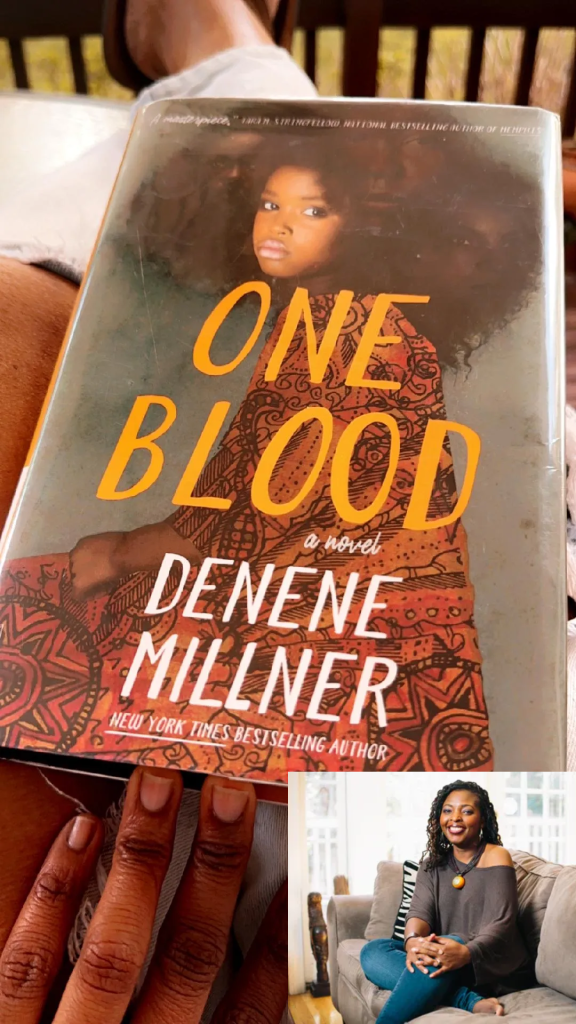
We Begin With Grace: A Mother’s Day Book Review – Denene Millner’s “One Blood”

Our grandmothers proclaimed that giving birth was closest a woman got to dying without actually…dying. Denene Millner’s ‘One Blood’ reinforces this notion. From preteen to post heart-attack there’s much resurrection in her words. It is a book that hit close to home as I am a Maternity Nurse by trade. Scent. Scent of earth and fresh rain comes to mind when I think of blood. I was never repulsed by it. Trust me, there are so many other things to be repulsed by. Blood is controlled mostly by the pumping of the heart. For women, the heart lends its control over to reproductive organs every once in a while and they (the heart and reproductive organs) do a little dance. I’ve always admired the cardiac care team. The heart is tricky, beats to its own drum, has its own rhythm. If cardiac nurses and doctors were artists, they’d surely be musicians. The women’s care team – painters, and of course writers. This book is part of the women’s care team and may one day be required reading for anyone looking to enter into that…this field of work. If ever one really wants to learn the ins and outs of the community in which they reside (or travel through), do some birthing work. Where are the babies born? How are the women treated?

What does family and communal support look like? What are the treatment modalities? What’s an acceptable child-bearing age? There’s a veil that is lifted in ‘One Blood’ and behind the curtain we see the walls painted in different shades of red. Though the powers-that-be try with all their might to force the painter’s hand, the heart never gives up its authentic faculty. Thus, we begin with Grace.

The three sections of Millner’s book each feature a female character that wraps her story around our waists. Grace is the focus of the first section – a preteen who is eager to learn and knows both safety and ingenuity rest in her grandmother’s hands. Those hands hold so much of the surrounding community with a careful pull and tug. Grace’s grandmother is an essential midwife outside of the barren walls of hospital rooms turned birthing suites. She knows the color of soil is the color of old blood. Grace and her grandmother share this color. But, Grace must learn that there is pushback to this pull and tug. There is appreciation in the blood but there is also resentment. And so we ebb and we flow. Millner introduces the upscaling of birth certificates as what’s red and liquid has the man-made need to become black and white, recorded, readable and even punishable by law. It is this introduction of paper inked in red that finally highlights the truth (in black and white) – one is permitted to share their gifts until their gifts don’t align with the yellow lines headed toward the status quo. Grace’s story is complex and wrought with both intense love and intense loss. It makes the reader question our basic desire for what is good, what is better, and what is best. We follow her as her journey begins in South Carolina under the tutelage of her Grandmother’s birthing hands and continues in the North with her own hands catching her own baby. Sleep consumes her after such a tiresome journey and she awakens, still bleeding, the afterbirth likely still warm, with her hands empty. Her story is gut-wrenching, bidding a nod to social upheaval, the injustices that result from those clamoring to reach a wobbly pinnacle, and the innocence that is drug behind upward mobility. So, though we begin with Grace (and though her gift to the world within this book is deep, vast and wide), the journey will likely take us low.

Deloris is the main character of the second section of ‘One Blood’. She’s introduced as spunky, fashion-forward, and with too much life lived before her adult years. Folks refer to her as LoLo and within her world we see clearly who gives, who catches, who takes and who keeps. She’s expected from school-age to give as a mother would, as a wife would, as a big sister should. There are dangers in placing too much weight on bones that are just shy of cartilage. Further dangers lay around and about the taking…so much taking. A wall of secrecy is what guards LoLo even within her marriage. Yet, it is (adoptive) motherhood that finally peers beyond this wall and dismembers it in a way that’s as benevolent as humanly possible. Millner portrays both the hurt and healing that lies within this trickle of hematic lineage. Even if/when it (true blood) trails off course (willingly or unwillingly), gets placed in a dark basement, is hidden just beyond a southern dirt road, it can do good. LoLo’s story asks: who came to get you when you were hiding from yourself? And: how dim did it have to get before you realized you (and they) could see in the dark? Also: Why was it a familiar woman? She devotes herself to her husband and her kids, never being taught self-care or even self-knowledge. Her body and mind-frame are hammered, tucked and slid into the shape of a stage for everyone else to walk across. She is low so that they may be high. Major damage is done…but great is the rectification walking these characters from low and dark to solid ground during daylight.

The final section is the Book of Rae. Rae teeter-totters between the desires she knows not of having and the desires that have been handed down to her. We’ve all done it; looked up one day and thought… who’s curtains are these shielding me from the sun? They are surely not what I would’ve chosen to decorate my windows. Still, we have yet to reach an answer when one asks what curtains we actually want, if any at all. Thus, we utilize the ones that are already hanging. She is walking on a balance beam placed before her – to swim or not to swim (hair), to read or not to read (knowledge), to marry or not to marry (connection), to breastfeed or not to breastfeed (giving). She wobbles along until faced with the dismount and it is then she realizes the aching. She cannot help the origin of her roots no more than the sky that feeds them or the soil that cradles them. But, they help her. Rae’s story exposes the wounds of expectation (subtle familial and societal bullying), figurative and literal forced abortion, secrecy, medicinal modalities, and control – all under the framework of motherhood.

Millner writes in a way that leaves the stories open. Open to interpretation, open to dreams, open even to nightmares. Her characters are complex and imperfect. They are not placed on a pedestal; instead, they are seated next to the reader. We see their rich skin, full lips, soft hair. We see also their pain and their process. Motherhood is all-encompassing work. It is as messy as the birthing floor but somehow still unsullied. Even when we are imperfect, this woman’s work of lineage shows perfection; gives back what was taken, proves man-made…lacking, reminds us of the importance of caring for the hands that hold up homemade. Grace, LoLo and Rae tell a tale of mitochondrial blessing, a tale as old as time and as true as blood – we are one, we are love. We are FULL of grace.

Citation:

Millner, Denene. (2023). One Blood. United States: Tom Doherty Associates / Tor Publishing Group.

Featured

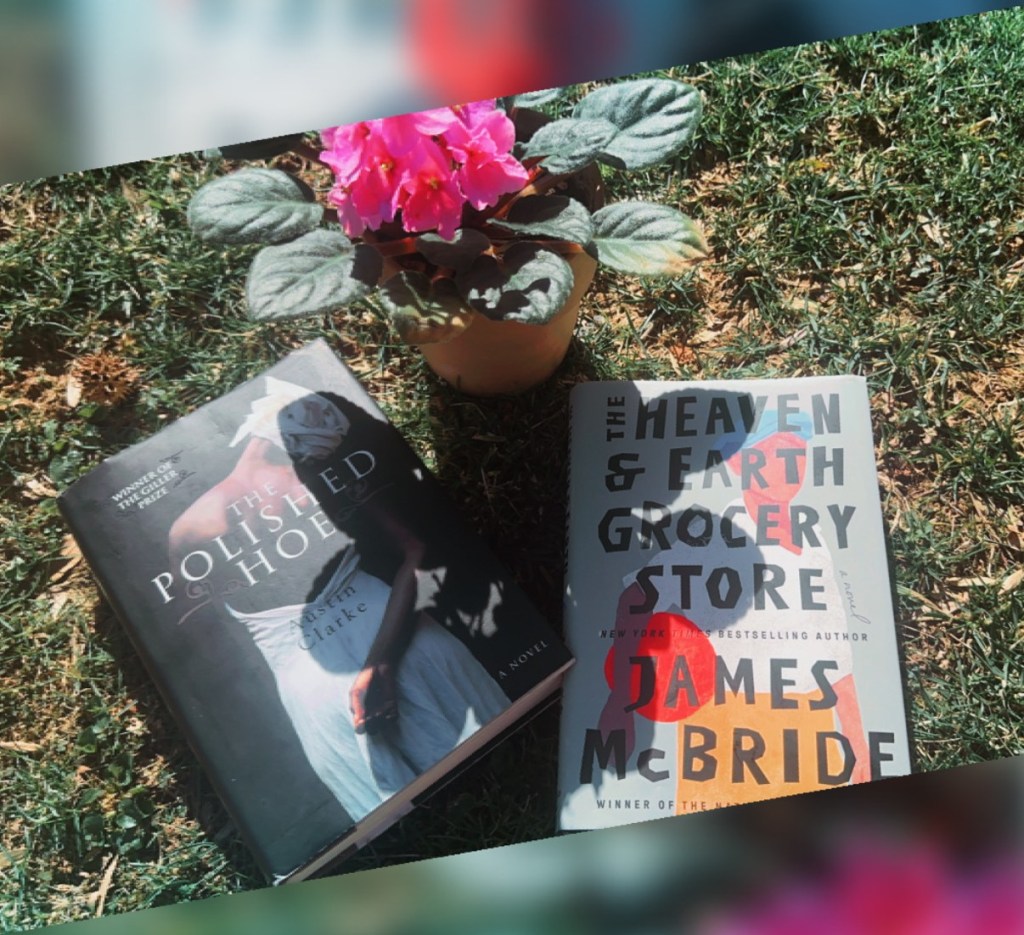
Transactions of Truth: A Book(s) Review – “The Polished Hoe” / “The Heaven & Earth Grocery Store”

Richard Wright’s opinion of Zora Neale Hurston’s Their Eyes Were Watching God was that the novel fell short of its political duties. He wrote, “the sensory sweep of her novel carries no theme, no message, no thought… Ms. Hurston seems to have no desire whatsoever to move in the direction of serious fiction. Her characters eat and laugh and cry and kill. They swing like a pendulum eternally on that safe and narrow orbit in which America likes to see the negro live – between laughter and tears”. I write this as my daughter watches Percy Jackson; the portion of the movie where Medusa declares that eyes are the window to the soul and is successful at turning a rightfully frightened lady into stone…once her eyes are opened to the snakes upon Medusa’s head. What we are able to gain from a novel (or from anything) has much to declare about our own viewpoint, experiences, fears, weaknesses and strengths. It is cyclical; a give and take, an in and out…until it is not. 2025 is a heavy year and we are not even two months in. It is a political year; a year that needs to be reclaimed. This year already feels like Richard Wright’s scolding of Hurston’s novel. It feels like a man’s world. It feels like HIStory won ‘The Battle of Back to the Future’. Ugh. And ugh again. And thus, two books chose me shortly after the start of 2025. As if they were slid under a closed door with just enough light to read: Austin Clarke’s The Polished Hoe and James McBride’s The Heaven & Earth Grocery Store. Both reminded me that the male gaze can be beautiful in its realness…period(t). Both brought up the question: is there still time to stop and smell the roses while moving in the direction of serious fiction…or serious reality?

The word that kept coming up for me whilst reading both books was: transactional. Transactions are all throughout both works. This cannot be what Dick Gregory meant when he proclaimed that, “once you put on the magic glasses, you see things as they are”: https://youtube.com/shorts/euWo5M3ZFV4?feature=shared Unfortunately, I think it is exactly what he means. The Polished Hoe expands upon this transactional notion by the obvious play on words in its title. And so does McBride’s title. Both examine community – the building of, existing within, maintenance of and even the tearing down of such. What is allowed to seep through the community walls in an effort to keep said community afloat? Did we and do we still need the seepage? Are we still in the business of buying and selling…humanity (of all things)? There are strangers in everyone’s house in 2025. Medusa’s are on the screen, wigs abide in all colors and textures, and known voices echo out of unfamiliar square faces. Magic glasses might be just the welcome mat we need (or not). The truth is: transactions are not what they used to be. This is the good and the bad of it all. And the pendulum is still swinging, and we wish we had the energy to laugh or cry.

The Polished Hoe is set about a warm, sultry Caribbean plantation in the 1950’s with a female main character. The Heaven & Earth Grocery Store spans through the early 1900’s into the 1970’s in the developing faction of Chicken Hill (in Pottstown, PA) and narrates in various voices. Published in 2002 and 2023 respectively, we are reminded that time moves only in one direction – circular. McBride writes in the voice and perspective of Miggy, “their illness is honesty, for they live in a world of lies, ruled by those who surrendered all the good things that God gived them for money, living on stolen land, taken from people whose spirits dance all around us like ghosts.” Even though the worlds within these two books are separated by time, space and climate, most (if not all) truths travel with us; and one might even think they are reading these lines in Clarke’s book. Transactions – to surrender a thing, in a promised effort to gain another. It has gotten so deep into our bones, that our branches are now sharp and metal at the receiving end – shining even in the dark. Transactions are so much our norm, that we shop, buy and sell just to get a mental break. These authors understand this ingrained effort of give and take on a deep level and their narrated, prose illustrations equate to roses emerging from sticking sugar cane and cold concrete (even if one is plotting on selling the rose). The Polished Hoe sets up shop in the smaller houses surrounding the ‘Big House’ – black female bodies and sugar cane become one in the same and keep the cash register making that combined welcoming and exiting sound. And on Chicken Hill, there are many ‘Big Houses’ with titles like Church, Synagogue, Town Hall, Iron Mill and Pennhurst – sometimes you have to be deaf in order to truly hear when the register cha-chings.

The characters in these two books have truly lived. They pull on all faculties in order to survive the storm, chart it, and cover their loved ones. These storms come in the form of unsolicited courting and sexualization, bodily ailments, world wars, genocide and everyday family life. These characters transform in and out of flesh, bone, mind, matter through the lens of objectification. Through Mary Mathilda, we learn that a garden hoe’s value is linked to how well it can be sharpened and polished – if you can objectify something, you can weaponize it. Paper and Miggy teach us that once the objectified become learned, the cash register heads towards its own victimization before becoming all but obsolete. Everyone has a role that they play in infiltrating the Big Houses in an effort to… reframe them. Upon arriving at their helms, eyes are truly opened. And each author allows their characters (through the touching of another) to hold tight to a slippery and slipping humanity along the way.

Clarke writes, “it is a contest. There is no interest in the rightness or wrongness of a murder case.” And we are confronted with the utterly mean games we play at the front steps and back doors of the Big Houses. This blow is made bearable by the two bookends holding Mary Mathilda upright – Percy (a childhood friend turned township police sergeant) and Wilberforce (her well traveled, well educated son). Both know her because they are of her; and thus understand her to a certain degree. The understanding comes after the knowledge and all cash registers are silent when the two meet to create empathy. Mary Mathilda is human. Never mind the polishing of blades and wood or what it takes to survive cane fields and spying glasses from on-high. Percy’s respect and desire for Mary Mathilda is evident. He shows a deep patience for her story despite the obvious dread to carry out this duty of taking her statement. Finally, we learn that the law proclamation holds true – an eye for an eye, a life for a life. Transactions.

McBride writes, “but the loss of hearing had not decreased his love of music. Indeed, it had intensified it. / It was as if the magic of the hymn Dodo offered up had marched into the room.” And we see a transaction that can’t be bought, sold, mishandled – a transference of pure energy. We see magic…unpolluted. Through the interactions of Dodo and Monkey Pants, a fractured community is personified: a little white fella all balled up into a neuro knot and a motherless black boy post various literate and figurative explosions. A state of survival becomes something totally different once innocence is on the line. Just because a little boy cannot hear the music, doesn’t mean he cannot feel the beat and the rhythm and learn the movement of your lips as you sing the lyrics. So, we become more careful at what we produce when crippling one faculty only enhances another. An educated transaction.

If the characters in these novels were vegetation, they would be root veggies. If they were animals, they would be doe and bucks. If they were crystals, they would be soft pearls. Mary Mathilda and Nate Love – diamonds all the way. If they were directions, they would be annular – a north and south flipped on its axis, trying as it might to still work through memory and feel. They existed in times that had no space or inclination for highlighted pronouns, mental health diagnoses or even blog posts. They were Richard Wright and Zora Neale Hurston – both looking upon the garden hoe but seeing different value; borrowing each other’s eyes because the sun is just as blinding as the dark. Trust can exist in transactions. I think Richard Wright knew this. I think he needed it to be so. But, trust can exist outside of transactions; and I think Hurston knew we are in dire need of this being so. If we are to watch God, the zeros and ones would surely make us cross-eyed. Thus, McBride and Clarke paint with brotherly love and sugar cane, in all its HIStory. And they both get it – the selling of humanity and the rectification; how certain ideals had to be gazed upon before being placed underneath the pendulum. The main characters swing and they do not miss. The heroes and heroines are everyday, ordinary people – deep as roots and buildable as expanding pearls. Their mistakes were preceded by a passion that linked up with the end of the road and bid us a story of invaluable wisdom before letting go. Well done. Well done.

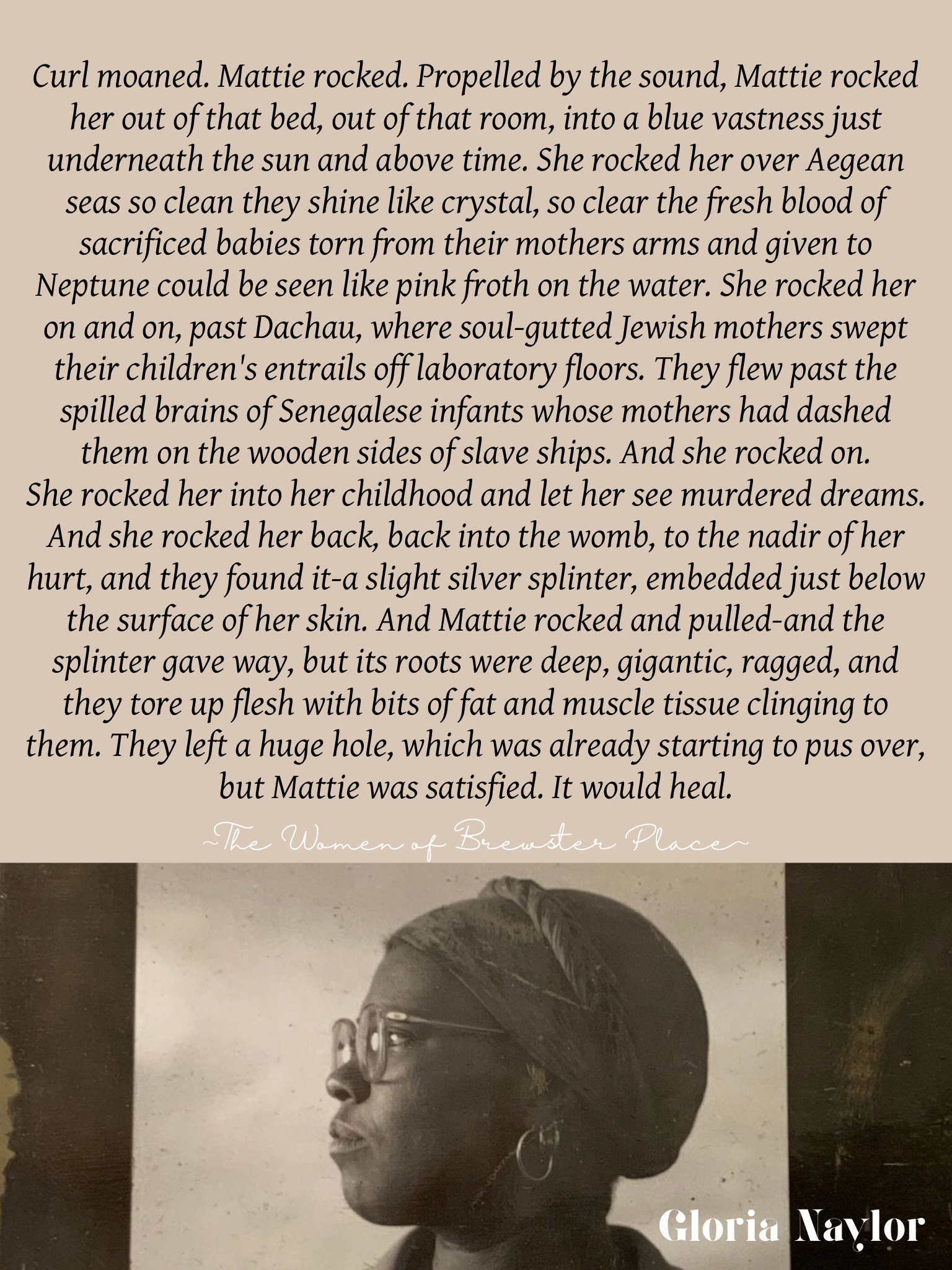
A few questions before and after your read: (1) In my opinion, these characters (in both books) exhibit a certain level of respect for self and others that I find suited to and exuded by (black) male authors. How might this outlook change if written by a female author? (2) Alice Walker writes, “In search of my mother’s garden, I found my own”. In search of your father’s Big House, what might you find? (3) Institutions play a large role in both of these works. Are our institutions more than just the buying and selling of goods? Why or why not? (4) Who are today’s polished hoes? (5) What are today’s Heaven & Earth grocery stores? (6) Are the killings in each book…necessary? If not, what else could have been done? If so, how do we rectify ‘thou shalt not kill’? (7) Chona and Moshe have somewhat of an arranged marriage. How do you feel about this? (8) How are the unmarried women in McBride’s book portrayed; and what are their options? (9) Is it just me, or did you ask yourself what in the world was up with Wilberforce? (10) Why did I end the review with this particular excerpt from Gloria Naylor’s The Women of Brewster Place? (11) We speak a lot about the objectification of women (and rightfully so). But, how are the males objectified in both novels? (12) How does one break free of the value placed upon their heads by outside forces? Is it even possible? At the conclusion of each novel, are Mary Mathilda, Sergeant Percy, Nate Love, Dodo, Monkey Pants now…free?

Citations:

Clarke, Allen. (2002). The Polished Hoe. Canada: Thomas Allen Publishers.

McBride, James. (2023). The Heaven & Earth Grocery Store. United States: Penguin Random House.

Wright, Richard. (1937, October 5). “Between Laughter and Tears”. New Masses. https://www.dentonisd.org/cms/lib/TX21000245/Centricity/Domain/490/Richard%20Wright%20on%20Hurston.pdf

Featured

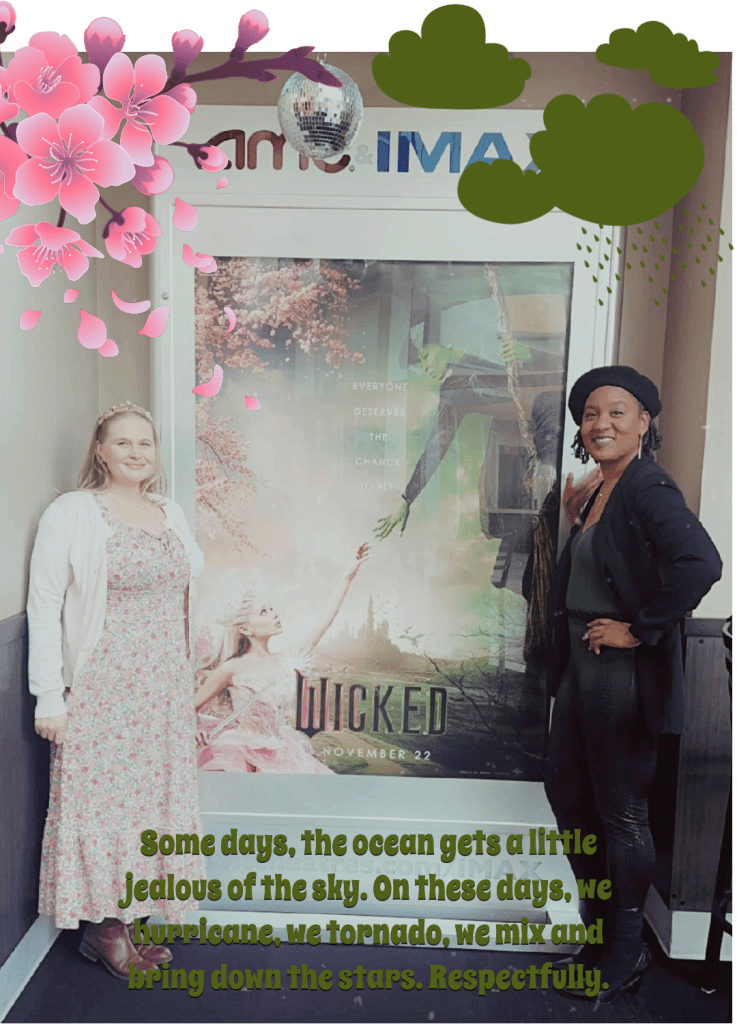
EVERGREEN: A Female’s Gaze Into the Motion Picture “WICKED: Part 1”

I had expectations when I went to see Wicked. My preconceived notions circled around the 1939 American musical that I’d seen numerous times as a child – Dorothy and her checkered blue dress, the yellow brick road, tornadoes and other natural disasters and how we are helped (or hindered) through them. Pleasantly, my expectations were shooed out of the way to make room for fresh notions. And when it came to navigating idealism surrounding new, old, and everything in between, Wicked did not disappoint. It is perhaps a miseducation made right (by exploring many left turns) and a green finger pointing to places where you likely had a main character all the way f’ed up. The protagonist (well, one of them) of Wicked is complexioned green. Green is the color of springtime grass, newborn intuition, nighttime blue mixed with sunflower yellow. But green is also envy, a nauseous disgust, a miseducated neo. Duplicitous at least. But I must say, no matter how green they wished Elphaba to appear, her ebony brown could not be erased. She became almost hazel in complexion. She became. She became. She became….undefined. And I think this was exactly the point to be made: though perhaps undefined, neither brown nor nude, doubly spotlighted and back-staged; she was present. Asking so many important questions at just the mere sight of her. The film opens with the echoes of explanation – a question answered. How did the wicked witch die? The imagery is spectacular. She was melted; a bucket of cold water thrown about her by a…child. The question answered by a youthful, female voice. If it had color (the voice), it would be pink (an obvious nod to the femme); not quite pastel though. The water is reflective, as are the sentiments surrounding her death. The town erupts in cheerful song. They are glad she is gone. Dreams and nightmares, fair weather and natural disasters, above and below, black and white, blue and red, pink and green; opposites exist because of each other – like life and death. The townspeople are all too glad that Elphaba is dead. They erupt in song at the notice of it. But the song is not a negro spiritual telling of amazing grace; or even a lamenting church stomp. The song is whimsical, seemingly uplifting. It is a springtime song. If the song had color, it would start out as green and end in diluted red with a yellow center…the way buds do.

Thee Hat sits atop this puddle of water; trying (as it might) to hold down a heaviness of emotion, stinging stark comparisons, imagery that won’t be silenced, a past and future catching up with us all. The film adaptation of a musical stage play. The musical adaptation of a novel. Art imitating life. All spanning from a story that deserved to be told. Proof that things done in the dark of night do indeed come to light; these things may be some variation of brown and nude…but, sometimes they are green (and on fire). It is the music of digestible birth, a swallowed-down death, a chewed upon school lesson, a dream not deferred. This water is reflective indeed. So, this is what we do for the entirety of this film – reflect. Who is this seemingly wicked witch? And why is everyone so darn glad that she’s…dead?

“Last Spring, something was…off.” -Shimah Easter, In The Way

Water mostly suffers gravity. What makes it rise? Pressure. Unless, of course, you are Galinda (the good witch; please don’t forget the guh). Where in the hell is Oz anyway? I was recently asked if I’d ever visited the ‘Land of Oz’. Apparently it’s right up the road from me in Beech Mountain, NC; complete with a yellow brick road and hanging willow trees. I initially thought the question was asked out of some weird humor or contempt. Afterall, my eyes are not blue or green. They are the color of brown – like old blood, like fallen leaves (and their season), like afterbirth. Do I look like I’ve been to Oz? Maybe to him I do. And so, we come upon the idea of the onlooker’s gaze in comparison to our own. How is it shaped, molded; what is it’s conversation with itself and others? The gaze is quite possibly Elphaba’s Achilles heel. It marks her as different even at her conception. It says: I will be seen…but so will you; in all your intentions, agendas, quirks and secrecy. Elphaba was born to a mother wearing red and a fellow who came in the drunk of night. Was she conceived out of love or lust? I don’t suppose it matters whilst your mother is rightfully married to the prominent governor of a whimsical town. Here, the lines between age appropriation become fuzzy. For, indeed we are portraying grown folks’ business; no matter how said business might affect the resulting offspring (green or otherwise).

“Chemical warfare is the only way to describe what happens when cheap perfume, body splash, body spray, underarm deodorant, curl activator, hair spray, and pissy Pampers collide.” -Sista Souljah, The Coldest Winter Ever

It has been said that prophets are born with their amniotic sac intact. Glinda is introduced to us in a pink bubble that seemingly only she herself can venture to burst. This imagery, again, is interesting as it brings in the ideals surrounding conception, birth, and how one (specifically, the female form) is held. Her answers to the townspeople’s inquiries are not really prophetic in the traditional sense of the word however. She did not conjure them through a dream, or a lightening bolt of revelation… She simply told a story of sight both within and out of friendship. Glinda is in a sense, allowed to burst her own bubble with the inner tap of her glittering, dainty scepter, hence becoming the one left to tell the story. The glowing sounds of the townspeople both keep her afloat and allow her to land safely, on higher ground. Elphaba is left in a puddle of (perhaps) her own amniotic fluid; I suppose the sac could not survive the poking of the broomstick. She is seemingly held by…no one. Instead, her wooden likeness is literally set ablaze. Her burning is celebrated. It’s quite sick when you think about it – enough to turn one green. I connect with lyrics and quotes based on extant resonance. And I distinctly remember the following line of the film’s opening theatrical tune of [No One Mourns The Wicked]: 🎶 through their lives our children learn / what we miss when we misbehave 🎶. Elphaba becomes a lesson on the importance of being remembered fondly; and the dire implications of the contrary.

“Freeing yourself was one thing; claiming ownership of that freed self was another.”  -Toni Morrison, Beloved

Elphaba’s mother (Melena) dies following the birth of Elphaba’s younger sister Nessarose. Prompted to chew milk flowers by her husband, Melena’s second born was indeed of Mr. Thropp’s desired complexion but also premature and paraplegic. What results is a comparable doting over Nessarose, placing Elphaba in a servitude stance that leaps over the basic big sister role(s). Elphaba is packing weight and no one is teaching her how to use it…. Until she travels to school with Nessarose and is noticed by the school’s principal Madame Morrible. Conveniently rhyming with ‘horrible’. And we are brought to the gaze of usefulness: to be used or utilized; these are a colored daughter’s options. It is perhaps Madame Morrible’s job to recognize potential in the pupils of Shiz Academy. But we are familiarly reminded of the history of exploitation. I must admit though, my own naivety and hopefulness would not let me believe that this sort of ‘taking advantage’ existed in the whimsical ethers. Yet and still, we adjust our gaze to the realities of a fantastical place such as an academy of even higher learning in a place called Oz. Madame Morrible sees this heaviness that Elphaba is carrying, but not until she sees how it transmits…as passion, as power, as impetuously raw, and useful. She takes Elphaba under her weathered wing and Elphaba is granted admittance into Shiz Academy (with room and board). Even in Oz, there are transactions. Even in Oz, there’s yucky pandering. Even in Oz, a woman of power has the title of Madame. Even (perhaps especially) in Oz, the idea of being ‘chosen’ comes with a bill.

How can you tell she is not you? ” -Alice Walker, A Poem Traveled Down My Arm

Toni Morrison states, “We speak, we write, we do language. That is how civilizations heal.” And in this film, the idea of language is profound. The animals can communicate in the same language as Glinda and Elphaba. In fact, the academy’s eldest professor is a goat and life science instructor by the name of Doctor Dillamond. What is profound shall likely be placed under attack. And thus, language comes under attack at Shiz academy, in the classroom, in the library, within the mouths of creatures and finally atop the hill in Emerald City. The femme gaze tries as it might to counterattack. We see this in the silent, animalistic movements of Elphaba at the ball. And we are relieved and emotionally pulled toward these movements as Glinda joins her archnemesis turned friend on the dancefloor. Frustration, rejection, genuine concern for self and others can finally be transmuted into tears flowing down Elphaba’s cheeks. The eyes see, the ears hear, the body moves in response. And we are reminded that whether within the walls and gardens of an academy or atop a verdant hill, this is indeed a man’s world but it wouldn’t be nothin’ without the animalistic movements of a femme, paired with the knowledge of a forgotten tongue, and a passionate need for activism. We are briefly introduced to the Scarecrow, Lion and Tinman as well. Through the female gaze and within the framework of ever important language, the foreshadowing in Wicked (part 1) lends a nod to the academia-impaired Prince Fiyero as the Scarecrow, a rescued feline as the Cowardly Lion, and the love-missed Boq as the Tinman. They all, as in The Wizard of Oz, are in search of something – smarts, courage, heart. However, they do not appear to be as aware of this need as are their femme-fellows. Go figure. Wicked differs from the majority of fairytale-esque films and media adaptations in that its female prototypes exhibit power. Glinda’s power lies in her ability to hone in on the embodiment of prestige, popularity, pretty privilege and ambition. She’s a natural born influencer. Elphaba is just raw, unadulterated (pardon the pun), flick of the wrist and flick of the tongue…power. Though both venture to journey towards the Emerald City, and even must await an invite, or a plus-one guest beckoning; neither Elphaba or Glinda are your typical ‘ladies in wait’.

👸🏾 We listen. We don’t judge. 👸🏾

“The front of my head feels like a house, and the thoughts reside within different set places that I can rearrange like furniture, but mostly I don’t. I come from a furniture-dodging tribe. We tiptoe around the pieces as they remain in place. I’m thinking that way again. Strange, the small things that make us proud.” -Alice Randall, The Wind Done Gone

As I watched Glinda and Elphaba enter into the Wizard’s den, I could not help but to ponder on this: to be used as an agent of war (knowingly or unknowingly) is a special kind of hell. And so, we are finally met with thee masculine gaze as the scene turns industrial, robotic; sharp edges and erected plans abound. The matriarchs of my family would often say, when we were coming up in corporate America (or the likes) and hit a snag at work, “Did you have to meet with the white man at the top?” And we knew exactly what they meant. This meeting has a sort of finality to it, a resolve, a truth, a lifted veil. Will one be pleased with the outcome? Before answering that question, another arises: can this Wizard read? Like, at all? He looks upon Elphaba with a sort of bewildered wonder. And the onlooker thinks: who’s been awaiting whom? She is shown his plan of Emerald City much like a business deal; a mini rendering of The Land. The idea of color becomes prominent once again as Elphaba and Glinda ponder suggestively on what color the brick path should be. Does the white man at the top seriously want them to pick out the supporting color palette for his already emerald city? Ridiculous. Perhaps they are to choose window coverings, bed linens and the countertop stone too. I was told recently that women are currently, “drunk with power”. To that I say, how power looks on one might be quite telling of what power has done to the other. To that I say, what one does with power is very telling. To that I say, we are our father’s daughters and we can read (even between the lines). Choosing the right book? Now, that is another story.

“Pay attention to the shape of things. Really pay attention to the shape of things. You just might be an Evergreen.” -Shimah Easter, In The Way

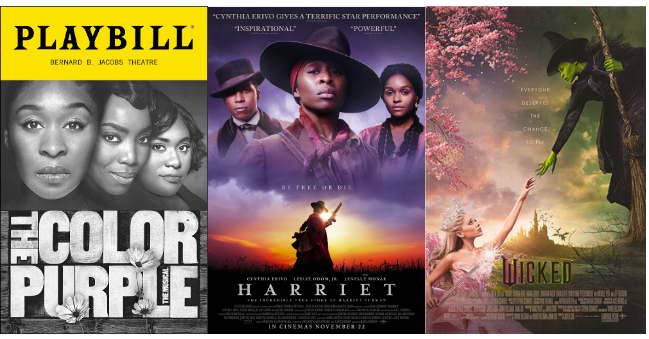
Cynthia Erivo’s roles as Celie in the Broadway production of The Color Purple and as the slave-freeing ‘Moses’ in the film Harriet both follow a sort of parallel climb up a top-slim mountain. The paths are surely due to merge eventually. Such is the same for Elphaba. As Araminta Ross transforms into Harriet, she coaches another runaway slave while on the ‘road to freedom’ and accosted by would-be slave catchers, “you know your master better’n the lines in your hand; be him!” And the fair-skinned lady is not only able to pass as free and white, but as a young man with town stature. She’s asked if she is perhaps related to Luther Grant. To which she replies, “well yes sir, he’s my daddy”. I can’t help but wonder if the hat she tips off to the fellas as they are granted passage across the bridge, possibly belongs to her daddy too. We see, we resonate, or we are repulsed. We grow, and realize that even the repulsions are a part of our fabric. You see…blame is much easier to hold than responsibility. Responsibility is a heftier pulling-together, for it is evergreen – keeping its color throughout the year. I end with a snippet of the late Nikki Giovanni telling of the importance of choosing what to pick up…and what to lay down. On all the paths back home to oneself, I hope you don’t neglect to pick up love and that your gaze be forever, forever, ever… Evergreen. 💚♥️💚♥️💚

Full interview: https://youtu.be/yCRfeodnVBk?feature=shared

Maguire, Gregory. (1995). Wicked: The Life and Times of The Wicked Witch of The West. (D. Smith, Illus.). Regan Books. United States.

Jon M. Chu (Director). (2024). Wicked: Part One [Film]. Universal Pictures.

Nikki Giovanni. Radio interview: The Breakfast Club 105.1. 11 November 2020.

Featured

Black Hx Month 2024

Feb. Nine – wise jawns

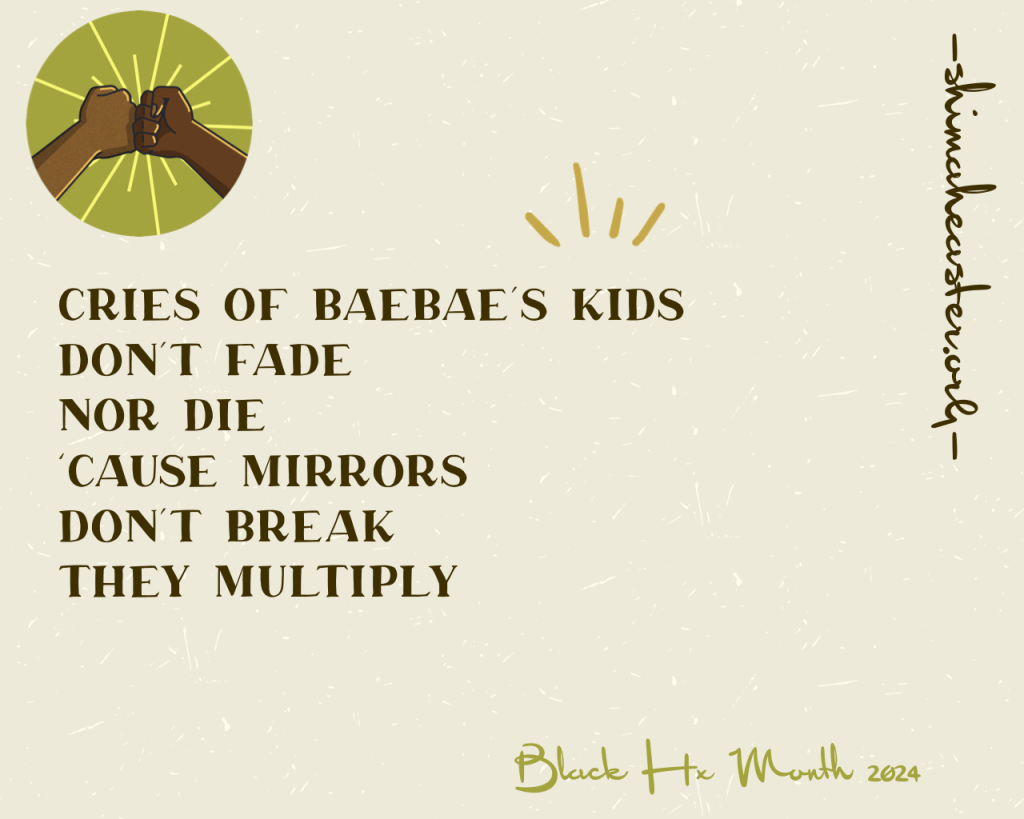
Cries of baebae’s kids don’t fade nor die / Cause mirrors don’t break / They multiply / I’m guilty of accepting fake hearts / So long as it’ll save my life / Guess ghost writers Be the real AI / Too ‘fraid to kill my ego / So I slowly watched it die / it’s dark as all hell / In the spaces between the whys wise whys wise… -Shimah

Featured

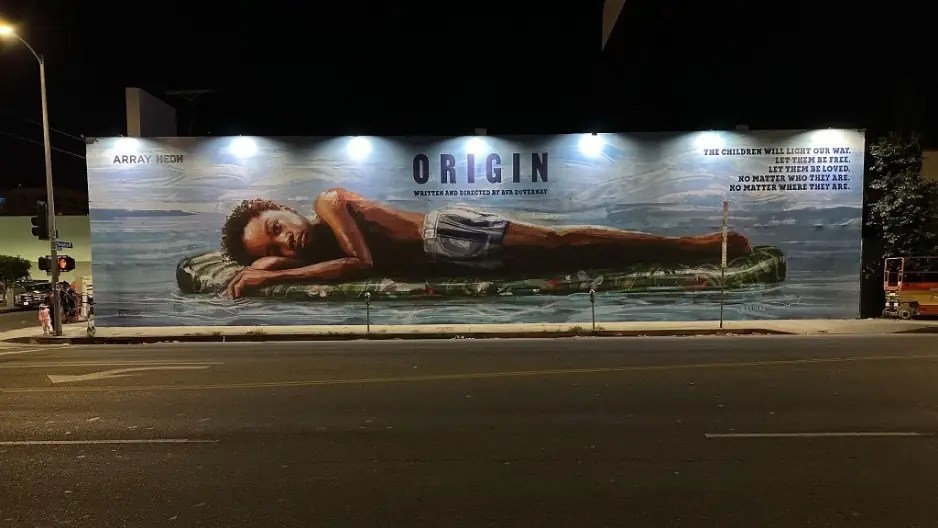
OIL: A few thoughts on the motion picture “Origin”

There are years that tear apart

Years that hemorrhage.

Years that kill all sorts of birds

(especially the ones that mock)

And years that go set out a watchman

To stop the bleeding.

Ava Duvernay’s cinematic interpretation of “Caste: The Origins of Our Discontents” written by author Isabel Wilkerson (simply titled “Origin”) was… tastefully naked. Like how we are born. Like how it was in the beginning. Like being told you can’t go back…there; with a side helping of all the reasons why. It is being inside of an ‘aha moment’ and being shown all of the scars the connective tissue has been forced to make – the baby must be born. So we wade through with a scalpel or a machete (whichever has been handed to you). Main character Aunjanue Ellis-Taylor holds her scalpel with a surgeon’s precision. I know this need for rest. I know this ever present conundrum of the shake and the sweat and the blood. My God, the blood. Yes, indeed the demons tremble. But what do we care of their trembling? We have our own. I watched her in earnest. Her impact was such that you could feel the loss, the anger, the understanding and the channeling. A channeling that had to be precise because, again: the ever-present, pesky scarring within the connective tissue (a tough yet delicate maze). They say it happens in threes. Loss. Death. Rising. And if you have yet to watch the movie, I urge you to pay attention to the idea of thrice. The idea of lying down in your own mess ’cause you simply can’t move until you see what color the walls fitna be. The idea of no walls; instead, the color of sky and the feel of green pasture. But first. But first. But first. The wading. She tells the black man beckoning the birth of her next written work that she wants to focus on family while pulling her white husband close. The nerve! The gall! What happens next is likened to being pulled into an abyss. What happens next is being the first to find the needle in the haystack; being told it wasn’t the needle that stuck you and that you are indeed not bleeding. What’s impressive is how (unlike what would’ve been my first inclination) Isabel chooses to not bleed everywhere. Because: just ’cause you can, doesn’t mean you should. Oil knows when to pour, when to hold back.

Her ink bled onto those who were not the culprit

But it was all in the plan

No one knew what her blood could do

Who’s the most dangerous being? Some say it is those with nothing left to lose. I say it’s the ones with every reason to be dangerous yet choose not to be. The ones who have been stripped of everything, left with nothing but a story to tell. And so they tell it. Leave it out in the open, raw, walking with you as you enter into the house of mirrors. I cried throughout the entirety of this movie. Which is to say a lot because the combination of 2020, 2021, 2022 and 2023 left me in a drought. So, I had to ask myself, what’s pulling at the bucket of this seemingly dried out well? The answer: none of us are safe. No matter what our ancestors have endured. No matter the letters behind our names. No matter. No matter. No matter. Pedestals only exist in the way of hanging trees. Trophies only exist in the way of bludgeoning objects. Beloved books and the stories inside only exist in the way of bonfires despite such eerie warmth in winter. Isabel is dangerous because she could swing from a tree in her grief-stricken freedom, beat someone over the head, tear a whole in the walls of her own house and her mother’s (just out of pure rage), burn the bridges that are every line in the stories she’s written and have left to write. She does none of this. Instead she lies down in green pastures and looks grief in the eyes. Reminiscent of the Spike-Lee-esque double dolly shot, Duvernay creates the same symbolism with stillness and a sort of…grounding. Isabel is dangerous because she endured the house of mirrors and chose to create. She saw a blurry string of consciousness that linked us all and chose to grab hold of it. She walks it like the tightrope that it is. Oil knows the ins and outs, the cracks and crevices.

Couldn’t be me…

Oh yes, the hell it could be 

And has been

You

In the beginning, we have our own ideas and ideals of what life should be and should become. Some have met this idea, most have stumbled upon something utterly different. Celie’s sister and children return. None of them smell the same. We see this same truth with Isabel – finding freedom in obligatory travel, obligatory hard discussions, at the bottom of cesspools, at the end of her spouse’s, her mother’s, her best sister-cousin’s…absolution. The love returns…different, grown. We have put on an armor and must deal with the discontentment, the realization that not only is the shit heavy but it’s wildly (sometimes laughably) inefficient, a block, and a fog. In the beginning we spoke of union and freedom in the same breath. Now we haughtily wonder why the next breath hesitates. We went so far as to project the worst case scenario into our forefront so that we might test this armor. And this armor is splattered about the Caste system. It is why black love has been and still is so political. It is why we are now in a last ditch effort to reframe our essence as kings, queens, high value men and high value women. It is as disgusting as classifying an entire group of people as ‘untouchable’. Yet as understandable as ‘passing’, as surviving. This armor chokes us still. And as a woman is left to tell the story, she is also left with what to do with the heavy armor that a white male spouse has been made to hoist, that a confrontational mother has been made to hold onto, that a cousin has been made to drag behind her like an oxygen tank or an IV pole, that a world in and outside of herself has told her she needed to carry in order to be safe. The oil knows: we cannot be free and safe at the same time. The oil knows: it is natural to desire both. The oil knows why you sometimes hesitate to breathe the next breath. The oil knows the healing powers of one touch from an ‘untouchable’. The oil is their armor.

The only cast(e) I know is a skillet and the rolling credits of the movie reel.

Here, the shot callers and the bullets are all the same such that you know the source.

I wish.

We are walking oxymorons. Educated fools. Dry rivers. Silent screams. Maybe even worse; we are stagnant in these rivers of knowledge. The oceans are getting saltier still. What is the house just past shame? Complacency? Perhaps. If so, I’ve been there; and I can assure you Freedom left a long time ago. Asking a system of caste to give us us freeee is insanity in a bottle – dirty water claiming to be holy. And in this current atmosphere of throwing the whole rearview away, Wilkerson and Duvernay pull out that ol’ string of consciousness (that links us all) yet again and places the rearview (with all it’s cracks and brokenness) back where it was. Isabel’s eyes are there, broken roads are there, waves of goodbye are there. Harsh truths are there: the realization that some of the people we love did some really foul things in an effort to protect, the realization that some of the people we despise did the same, the realization that the ladder used is likely identical; this ladder, now in a museum that bears every last name we’ve ever muttered. In this moving vehicle, all glass fixtures must work together, in tandem, with the assistance of your eyes; and none of them require your forgiveness in order to just be. We are fearful of the rearview and so we fall deeper into a system that placed us there. This is how it’s been. This is not how it has to be. Oil will sink to the bottom, it just must be shaken up a bit. There are some souls down there to whom which it belongs.

And I ponder on this notion: perhaps the pain is bearable once one knows (really knows) they don’t deserve it. Perhaps this is all that has ever mattered if the intentionality was to truly, wholeheartedly, completely set free.

“Origin” was like watching a bouquet in motion (with the roots still attached). Its only request: wherever I go, to whomever I am handed, please, please let there be light! Even if it must be the coldest winter ever…please let there be light. Isabel’s review of culture, politics, religion/spirituality and their footprints on our hearts and minds leads her to a single string. We are invited on the journey as she traces back its knots and its unraveling. And we are reminded of the beginning so that we might knit a better future. We ‘belong’ to each other until we don’t. Some will send you off with, “be safe”, some will send you off with, “be free”. Each is so very telling if we just listen. The oil will remain with you either way.

There are years that give flowers to the artists that dared write. And write again. There are years that keep righting.

DuVernay, A.; Garnes, P.; Bremner, S. (Producers). DuVernay, A. (Director). 2023. Origin [Motion Picture]. USA: Array Filmworks.

Wilkerson, Isabel. (2020). Caste: The Origins of Our Discontents. Random House (US) & Allen Lane (UK).

Featured

A PSALeM 40 Days At The Well…

It hit the floor
And stood tall in quiet relief
Like only coarse things can 

You must be careful touching that which
Replicates itself a million times over
That which springs. Back.
That which is never too good
to scrub the floors
with steel wool accusations

All of the pulling
Pulling
Pulling
When all it ever needed was a gentle push

It would have given you what you asked for

You did not need to reach; to take

This business cannot be minded
Or mined
By anyone except whom the grower allows

I am telling you…
(Mind these words)
It. Is. Never. Too. Good. To. Scrub. The. Floors.
To come down to the bottom
When your stomach rumbles
And you look for a cold place to lay your head
Only to realize…
The middle spaces are rarely
Cold. Enough.

Comes down to meet you at your low
To show you high ways

I did not know. I am me.
I did not know. Who I was. 
Two of the same – in a different space and time

So, when the self proclaimed specialist of eggs, hormones and the like told me, “poets are dead”…

She scared me instead of inspiring me

And I was shocked at what this self proclaimed woman could birth from her mouth 

And I was betrayed
And I was quieted 
And then. I was mad.
And then. I was moved. 
In laboring anticipation
To scrub that damn floor
Better’n she ever could –
A self righteous rebellion
Will have you righting even the left turns
Making circles in the middle of nowhere
Ya know…hard-driven lessons that teach
Us the way back home

So let me learn ya this –
Do not touch my hair
In an effort to quiet my pin
Do not touch my eyes or my ears
To see how I watch and hear God
Do not touch my womb
To see who grows in there

Do not touch my mouth with your unwashed hands

I am no longer afraid of bottom places
For, we are fertile everywhere, every here, every there 
And next time
Next time
Next time
The high ways will stay in their place

I left behind all sorts of wet apologies in the bucket.
Borrow someone else’s mop.
You shall scrub your own floors.

The poets are alive. And well. And writing in the waiting. With a head full of fertile new growth. Standing tall in quiet relief. Figuring out how to clean the ceiling.


Featured

Blax Hx 2023: Stories & Fairytales

More on Arks and Middle Passages

Who knew the unlearning would seem as though a vice to even ourselves? Who knew it would feel like hell? Have you ever listened to Anita Baker’s ‘Fairytales’. I was afraid of this song as a child; along with ‘Little Walter’ by Toni! Tony! Tone! (I just got the chills). She’s singing the secret: my fantasy is over, my life must now begin. It’s a gospel song – rhythm, blues, and being saved so that you might save yourself. The pianist goes awwwf! Almost eight minutes of a blissful reality check. Because it matters who takes us to the other side. We got lost. And then found again. And again. Some of us just sat there until we went to sleep. And it’s ok. Maybe the rest is what saves you. God is in everything, anyway. And sometimes we are not Beauty or The Beast. Sometimes we are the wilting rose in the glass vase. Sometimes we are the mirror-mirror on the wall. Or the snow and waiting that falls around Snow White; the fireplace and waiting that warms Cinderella (and her stepsisters); the Cowardly Lion and a road the color of sunshine (just in case we look down) – perfect hiding places for His black sheep. He’ll put you into any story as he sees fit. We are reading lessons, rectification, sadness even in summer, love even in the flood. We are learning the unlearning until we are able to write our own stories, the right way – God, ‘Body and Soul’.

And maybe we read fairytales so that we can recognize the ones who came to pull us out of them. #MAHism2023

Featured

Blax Hx 2023: Battlefields, Arks & Middle Passages

Leave it all on the battlefield. Everything. Except your soul. #MAHism2023


They found her on the battlefield. She looked as though she’d traveled from some far off land. They’d get these types every now and then. Lost Souls is what they called them. But one took a second glance at her right wrist. It did not have the cut that many have. Instead there was a tattoo there. Something that looked like a funny bird with no body, no beak, no eyes. Just plenty of feathers. It bled down into the word LOVE. Many who landed here had tattoos and other bodily marks. It is how the locals learned over time how to read. When they lifted her lids to peer into her soul, a big strike of lightening pierced through their sky. All at once, they knew. She was indeed one of them. The kind who understood, all too well that eyes are windows to the soul; that your eyes will watch God. That the eyes must learn to mix fire with air else the earth and its need for water (and vice versa) will surely be ones demise. The kind who could will her own death by just being too damn still. Still waters are wicked deadly. She was the hardest to revive. The kind with too much on her plate. So she ate nothing. Gave everything. Fed everyone. There is a risk of too much too fast. She’d eaten the risk instead of the food. Then punished herself for not being able to digest it. She’d survived the void. Then punished herself for how she survived.
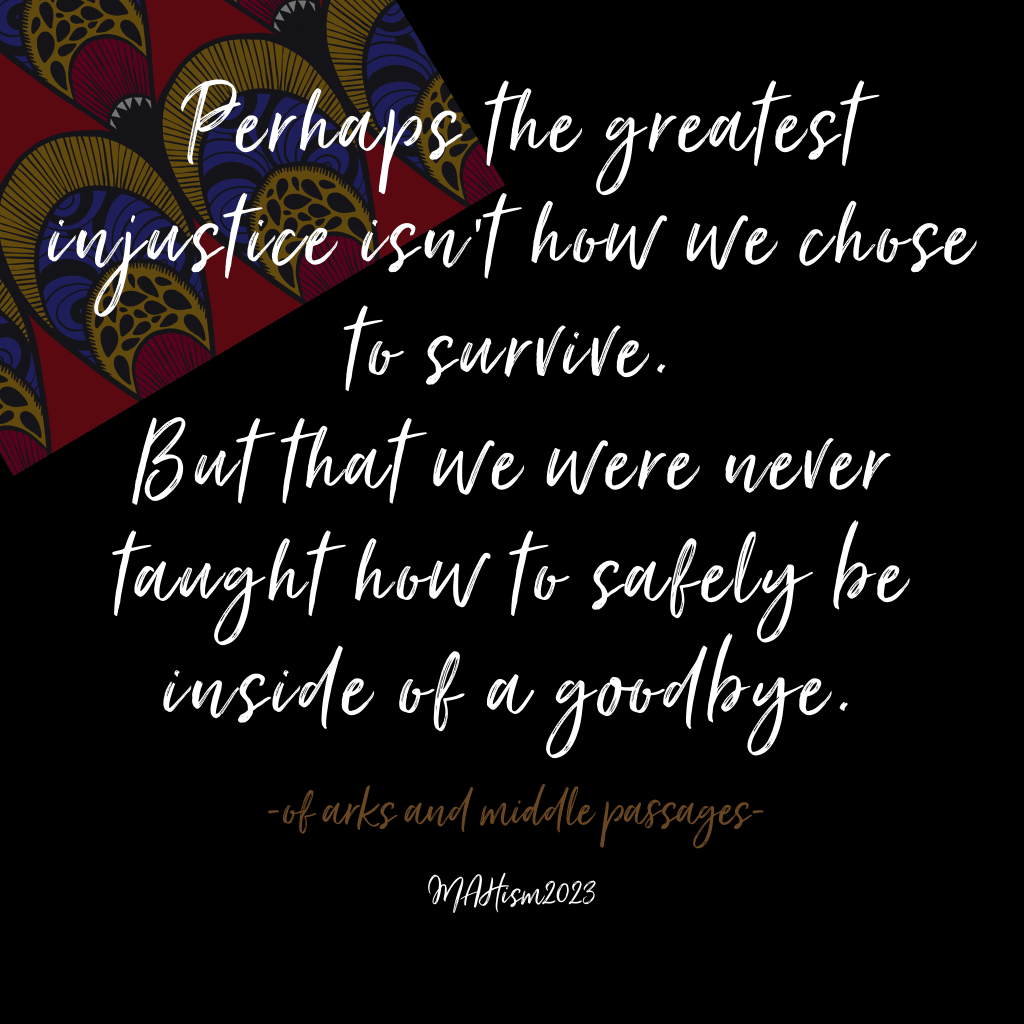
What funny beings we are. Perhaps the greatest injustice isn’t how we chose to survive. But that we were never taught how to safely be inside of a goodbye.
What were they to do with her? They tried walking through every fairytale known to man. Each ended atop a sleepy pedestal. The grandmothers watched on with a sly grin and shake of head. Until they could watch no more. Finally, they stepped in. Both took turns rocking. Rocking. Rocking. Back and forth – places no other could dare take them to. Finally she opened her eyes. Finally she moved her write hand, though it was sore and bruised and purple. And they returned her. Anew. Yet remembered. To her baby’s garden.

True story. 🤷🏽‍♀️
Featured

Blax Hx 2023: In the Name

There is power in your name. Study its history, its origin. Love on it. Write it down, ball up the paper, see how it unfolds. No matter how many hard or soft covers beckon its beginning and end; no matter how many faces they give it, there it is. Etched inside. Parting red seas. A water mark that recedes and washes ashore. Again. There is power in The Name – inherited or gifted. So keep going. Keep being planted. And rise again. And walk again. And cry again. And have joy. Again.

🌹- What is a thorny rose, if not judgement? If not a scented resurrection? If called by any other name, would it not rise again? #MAHism2023
Featured

Blax Hx 2023: Prince of ☮️

And we must learn to release the grip around our enemy’s necks. Free our hands for something…more. Forgive our dreams for being nightmares (at times). Give a fist bump to the things you once thought were ruining your life. Ride in cars with tax collectors, realtors, and practitioners. Ask the great Prince of Peace to take the wheel (of fortune; of misfortune). Get dog tired of the spinning. For none of it is ours to grip, to hold, [I 🙏🏽 the Lord my soul…] to keep 🤲🏽.

We made a game out of the word ‘Jeopardy’ and we’ve been spinning ever since. #MAHism2023
ˈjepərdē – exposure to danger or peril, loss; vulnerability; insecurity; a thirst for peace unquenched by riding in cars 🚗 with you and you and you and me.

Featured

Blax Hx 2023: Care FULL

Careful with your voice. It carries a vibration. Different than sketching words onto lined canvases.
When you speak it is a forced-feeding of sorts. It is your self outside of itself.
Walking beside another. Braiding her hair. Shaving his beard. Coming closer and closer to orifices that don’t belong to the original speaker. Being chewed, swallowed. Digested. Coming out another’s end – looking nothing like it did before.
Careful. With your voice.

The crushing. The press. Shows how you’ve been careLESS. The pouring. The pull. Proves the purpose of CareFULL. And I thank God that there is still more love, more grace, more forgiveness in the bottle. #MAHism2023
Featured

Blax Hx 2023: Broken Cages

Once we realize how imprisoned we are…. Only then can we appreciate broken cages Can we admit to the ache in our wings Can we recognize the great importance of a call(in’), its song, and its flight

Featured

Blax Hx 2023: ☮️ by ✌🏾

I was born on an army base in Texas. With the word ‘kill’ leading the way – war shielding a precious love. Near borders. In desert-like summer heat. To parents who inherently knew the importance of 2×2; but too young to realize the gravity of the nails placed in wooden boards. Around the corner from docked slave ships dripping in blood. Women speaking in tongues that everyone knew just by the sheer gut wrench of their cry. These are the women who’ve been made to swallow their tongue else it turn into a serpent in the garden. These are the women in the good book that no one wants to be like. But these are the women of whom I take my likeness. The bayou will always be so. No matter how many doctrines have attempted to flood out the shore. No matter how loud the gunshots are outside of libraries. No matter how much tar we’ve placed on the bottom of our feet. No matter how circular the journey due north becomes…. We hurt everywhere. How did we manage to leave anything but an apology behind? I thank God for grandmothers smart enough to take on coverings that were foreign to them. Strong enough to hold the secret through generations. Sometimes I feel as though I am coming out of my skin. At first it was a crawl, then a gallop, and now a flight. But then my baby smiles into my eyes. I get some reprieve from gazing at the cross her father, grand, brother, mate hangs on. And I remember how far we’ve come just by apologizing for the time and place of our births. Slick yet loud. Like black ice and pool balls. And I remember His footsteps looked slightly off center because I kick and scream in my sleep. And I remember now is the time for something different. Finally. And I remember. That this time the journey may not require an underground anything. May not require a bridge burned or flooded. Maybe this time the softness will come to us. And I remember that we are worthy of just that. And I remember – whether alive to tell the story or speaking from the grave…none of us have been brought this far just to be left behind; for it took grace to get us here, faith to lead us home.
And I remember… ☮️ by ✌🏾

Featured

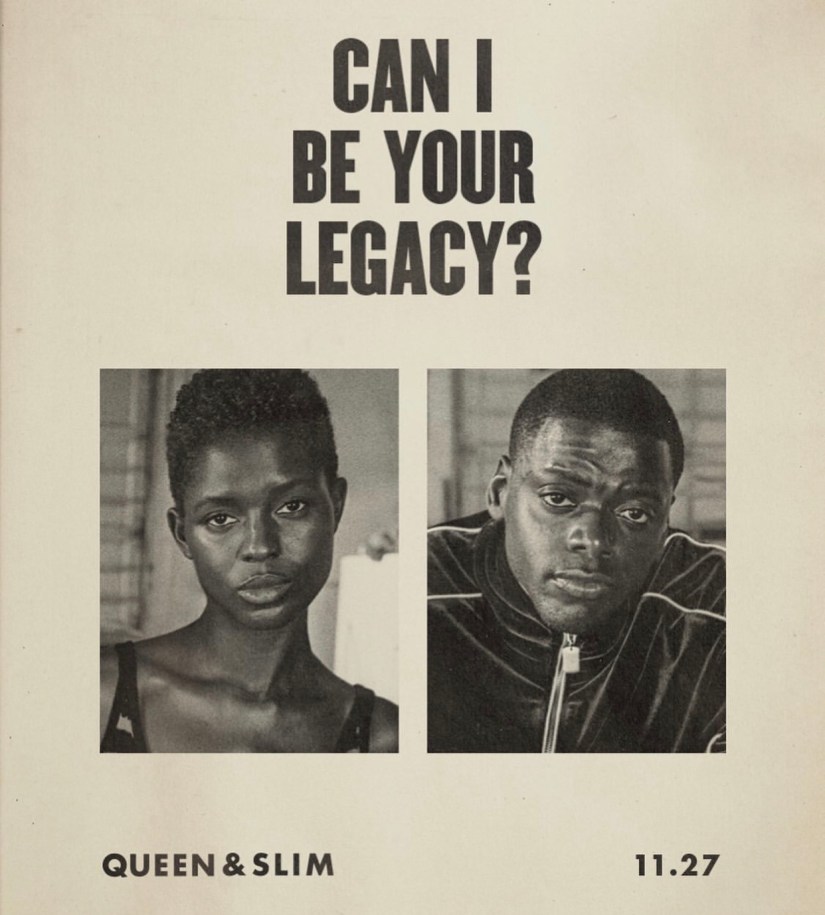
‘read’ lips: can I be your legacy?

Since it’s coming to Netflix soon, I thought it fitting to revisit. #queenandslim

🥰
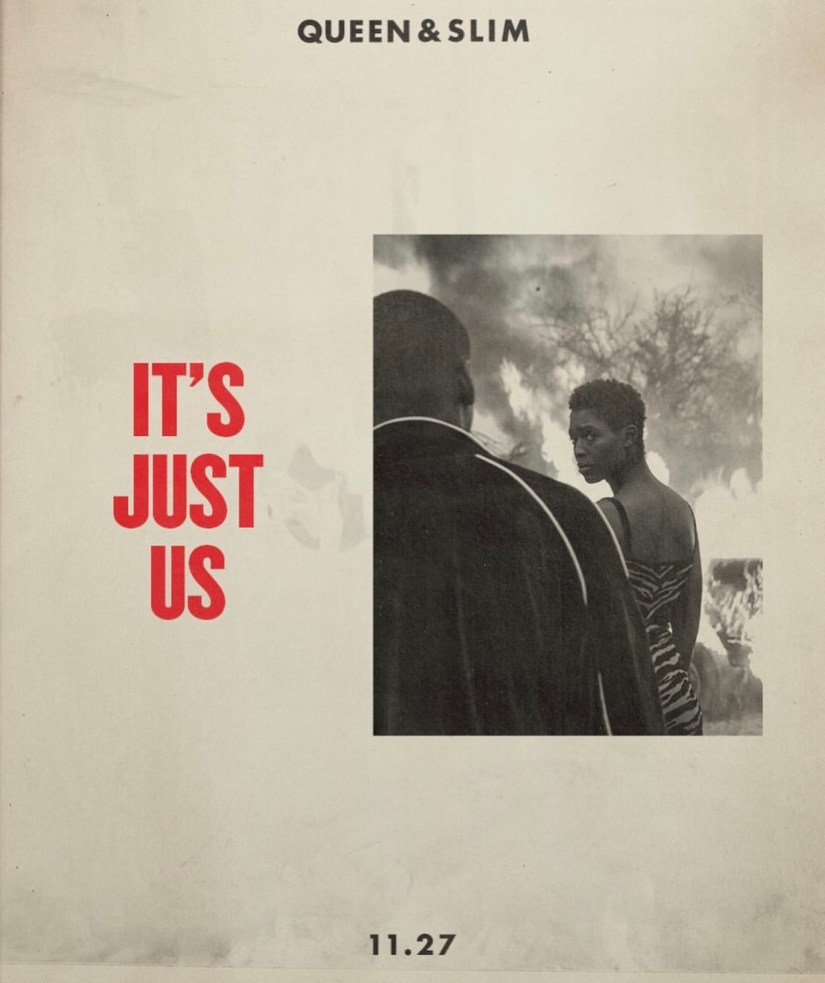
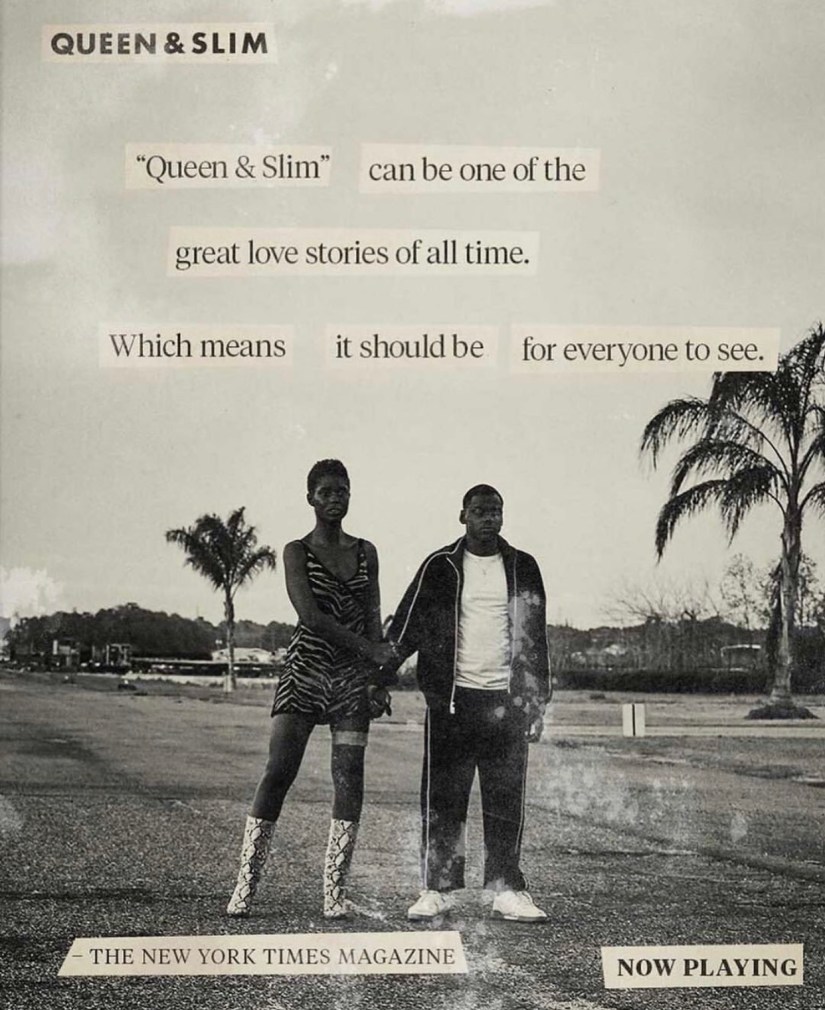
An Ode to ‘Queen & Slim’ – Once we’ve reached adulthood, it’s a question asked sometimes many times over. The connection of man and woman is after-all, fated towards reproduction…leaving something of value behind to carry your name, your tangible manifestations/successes, your physical features, your essence, your legacy. The flow of ‘Queen & Slim’ is well thought-out and executed in a realistic yet highly imagery-full way. It highlights the ongoing threat to this very natural way of movement through life as pertaining to the black masculine and feminine form when they dare come together to do what humans do – create a legacy. The movie opens with the start of such unions; a very modern-day scene as two semi-strangers finally shift from web interaction to face-to-face interaction. Angela and Ernest have their first encounter in a diner after a few weeks of online dating. The scene is dreary at best and both characters exude an air of boredom. Angela – lacking faith in all institutional structures that have come to frame her world, and Ernest – just…lacking. However, we are quickly brought into the exciting reality of just how much universal energy is pulled towards the connection of black man and black woman even at 154 years post American slavery and 65 years post Civil Rights Movement. The movie paints a picture of newness being weighed down by issues surrounding race (specifically regarding anti-black legal and social constructs) especially within and amongst two brown individuals attempting to join together romantically with any ideation toward bonding, building, creating and procreating, and (God-forbid) producing a sustainable legacy. ‘Queen & Slim’ is a roadtrip through the sweet, yet volatile, and at times outright terrifying beginnings of today’s black love. Below is a let(Her) from Angela’s (Queen’s) highest self, addressed to her other half, dripping in all the above…
read lips: can I be your legacy?
“It’s a theoretical truth… Black women look real nice dressed in all white.” ~MAHism2018

If you are reading this, I didn’t survive.  Pushed a bit too far, awaiting your return on the other side. It’s nice here. Better than nice. It feels like love walking, love talking, love growing (never going backwards); it feels like you and me…forever.  I promise, if I concentrate real hard and quiet my mind past the memory of my own mortality, I can hear the pitter-patter of the children we never had; I can feel the relief of a society that finally believed what we did was (w)holy in self-defense; I can dream of a future that never had a chance…know that it was and will be.  Our ancestors have reassured me that you are on your way. “Hush child”, they say. “Worry not. He’s coming to meet you.” They tell me that you’ve stayed behind, hovering amidst those you left, in an effort to provide for them and protect them in a way that you never could in the physical. And, of course I believe them with everything I have, because that is you – my earnest Ernest. In pursuance of love and duty of family in every way. 

If you are reading this know that I really liked you the first time we met. And if I’d had the chance, I would have told the few girlfriends I still had left just how much I felt safe with you. Even before the bargaining of your own pride with a white cop to save us both, even before the shots fired to hold down a rabid dog dressed in a pig’s uniform, even before driving us through the night towards my divided family and away from your intact one. You were so good. Not in a way where naivety could slip between your ears; but in the way where you could still believe. I envied you that a bit; it got under my skin – how you actually thought we could go back. How you needed the comforts of home so bad; not realizing how seeking those comforts would be a sure enough death before even living. I knew that I would have to be your comfort moving on. It was the least I could do. If it had not been for you, all three of us would’ve been dead within 20 minutes of leaving the diner – that devil-ass cop, me…and you. So yeah, I would have to be your comfort and that terrified the shit out of me. How do you give something that you’ve never had? How do you give to something that you’ve never had?  You didn’t require much of me…allowed me to be who I was, never pushed, only pushed back when what I said nudged your inherent wisdom, allowed space for me to speak of my past whenever I was comfortable (and not a moment sooner). Slim, you were…a too good to be true that needed a little edge and the comforts of home.  I hope I was that for you.

If you are reading this, know I’ve told my mom all about you. She likes to look at you through my depiction; a depiction outside of her own hovering energy. She was with us the entire time. She knew my uncle would make a safe space for us. Though she never agreed with his life choices, she will always be his big sister. And big sisters forgive – they must, in order to survive. She made our bed before we reached his home in New Orleans. She decided on a menu for us coming from off the long drive. She worked on his heart while he slept. Do you hear me Slim? She was with us the entire time…a maternal divinity shed of all the weight of the world stood beside our creator and made a way out of no way. This is how things are done on this side. A walking beside oneself, a walking with one’s legacy, a walking into one’s divinity.  She knew that our salvation hid in the sweaty palms of whore houses, good ‘ol boy trucks & pimp rides, a broken black daughter dressed in all white stained with her own blood, back-yard haircuts, 2 am braid unraveling, modern-day abolitionists who choose to repay their forefathers’ debt, gentrified Underground-Railroad-rigged houses, and black officers having an exceptionally bad day at work. She worked magic for us.

If you are reading this know that my entire life was formatted around a moment that would crash-land into you. I’d been through so much before that fateful night; before swiping right. So much, that the humble pie served by the familiar plump waitress was a welcome taste in my mouth. Feeding me in ways that allow the wounds to heal – turns scar tissue into butterfly wings. You taste like that pie. My body did not stop taking blows for you – the angels here tell me that is of divine design. My thigh absorbing the bullets of fear and willful ignorance, shoulder absorbing the shock of escape from windows on high. And if I’d had the chance, I would have stretched out my midsection many times over for you – watched your fingers as they traced the roads surrounding my umbilicus…retraced the way.  We were going nowhere fast without each other. And I’ll always swear on you. As I crossed over, the light wonderfully concluded in a mirror and there I saw myself for the first time. I saw myself through your eyes. It was the best moment of my life! Though most would say I was no longer living. Most know nothing of life or death.  If she is who you see when gazing at my form…then the saying is true! Thick thighs really do save lives. Together we were wounded woman in the passenger seat, slim eyes and midnight’s skin behind the wheel just trying to make it over a body of water to a place where we didn’t have to hide in plain sight. Together. We were. 

If you are reading this know that the sheriff with Native blood made it home to his son safely. I made sure of it. Know you can indeed…finally…dead the whole ‘ride or die’ antic…been there, did that. Who needs a t-shirt to show and prove when there are angel wings? Know that the cost of freedom is (and has always been)…everything. Know that your true downfall will be a nigga with nothing to lose approaching with a rifle…while you sleep. Know that we never had to be twice as good…ain’t no such thang. Know that my favorite place on God’s green earth was a movie theater – where nosebleeds are the best seats, and the tickets don’t vary in price. Know that the first bullet was from a white man, but the one that killed was from his wife, his daughter, his mother. Know that the entirety of our union was a road trip towards the sea; and my last words were formed into a question asked only to you, “can I be your legacy?” Shots fired, “you already are.”

Bilal and Raphael Saadiq = perfection

Queen & Slim. Film. Director Melina Matsoukas. Writers Lena Waithe, James Frey. Universal Pictures. November 27, 2019. US. 136 minutes.

Mentionable blogs and articles third-wheelin’ it with Queen & Slim:

We all 💭 it… Of course it’d be meme’d 🤷🏽‍♀️😂